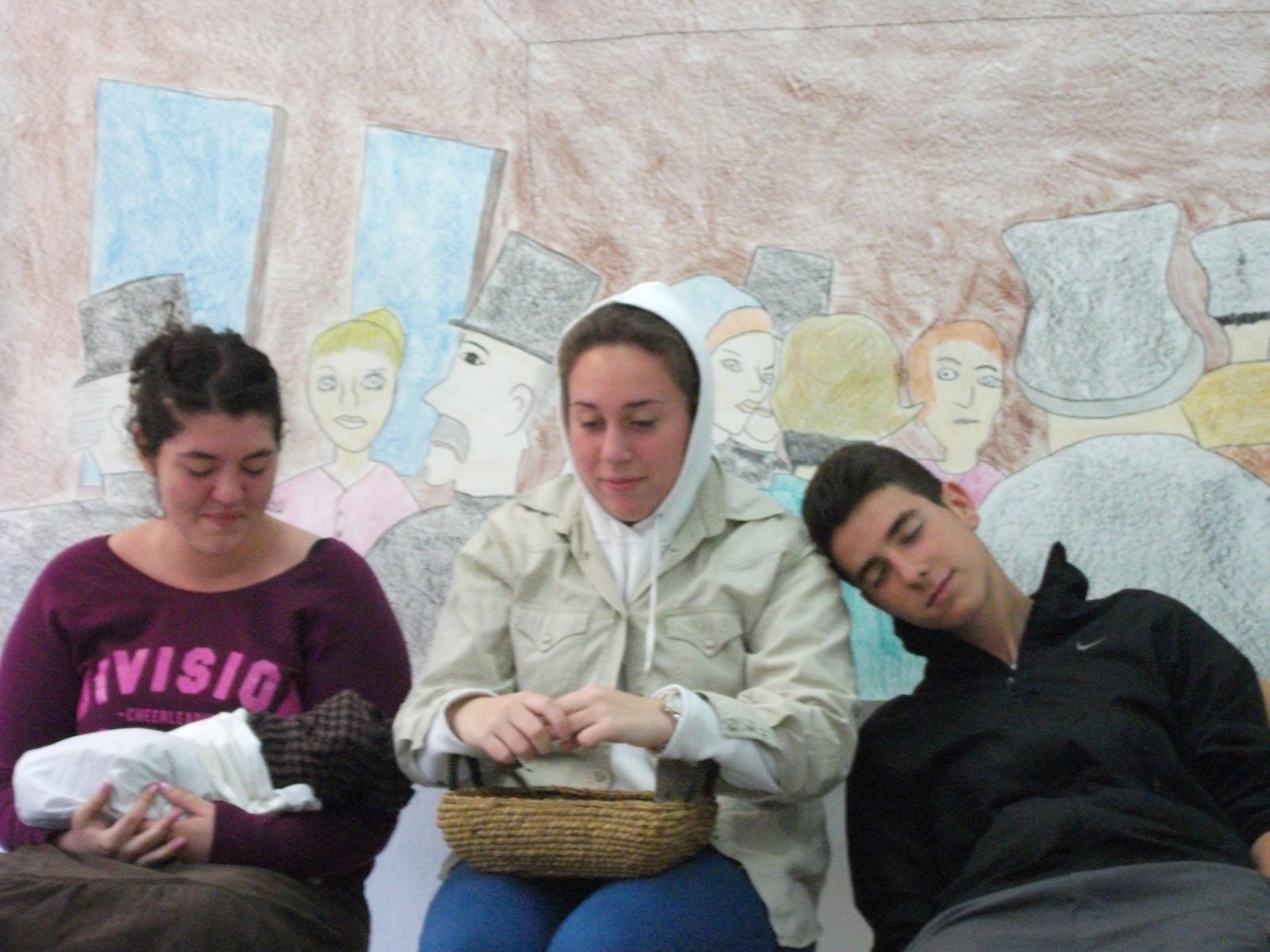
Students from Bachillerato brought some masterpieces into life on May 10th. This was part of their project on Realism and the nineteenth century. They studied the works of art and showed how the artists portrayed the society of their times. Pupils really got into it and enjoyed the experience! We will try to improve it for next year. Here are some examples:
The Angelus (1857-59)
Jean F. Millet
Museum D´Orsay, Paris.
The Stonecutters (1849)
Gustave Courbet
Gemäldegalerie, Dresde
The third-class wagon (1862)
Honoré Daumier
Thanks to you all for your collaboration! Many thanks to Rafael Muñoz for his enthusiasm and hard work.
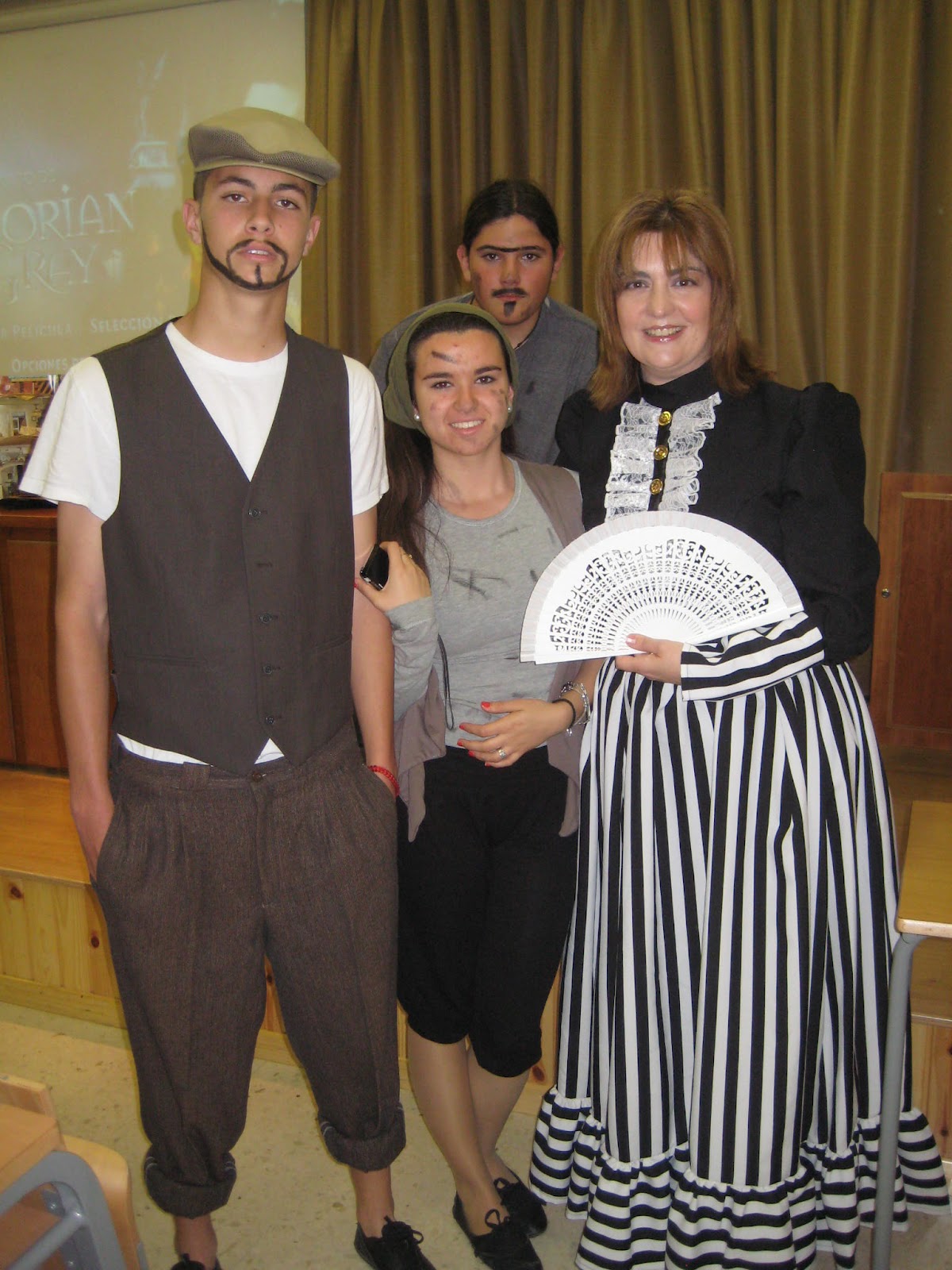
On May 2nd, students from ESO41 and 43 celebrated a Victorian day at school. ESO 41 students showed in their powerpoints how much they have learnt about this topic. They dealt with all the points that appear below on this blog. ESO 43 pupils dressed up following the Victorian fashion, We all had a great time!
In 1897 Mark Twain was visiting London during the Diamond Jubilee celebrations honoring the sixtieth anniversary of Queen Victoria's coming to the throne. "British history is two thousand years old," Twain observed, "and yet in a good many ways the world has moved farther ahead since the Queen was born than it moved in all the rest of the two thousand put together." Twain's comment captures the sense of dizzying change that characterized the Victorian period. Perhaps most important was the shift from a way of life based on ownership of land to a modern urban economy based on trade and manufacturing. By the beginning of the Victorian period, the Industrial Revolution, as this shift was called, had created profound economic and social changes, including a mass migration of workers to industrial towns, where they lived in new urban slums. But the changes arising out of the Industrial Revolution were just one subset of the radical changes taking place in mid- and late-nineteenth-century Britain — among others were the democratization resulting from extension of the franchise; challenges to religious faith, in part based on the advances of scientific knowledge, particularly of evolution; and changes in the role of women.
All of these issues, and the controversies attending them, informed Victorian literature. In part because of the expansion of newspapers and the periodical press, debate about political and social issues played an important role in the experience of the reading public. The Victorian novel, with its emphasis on the realistic portrayal of social life, represented many Victorian issues in the stories of its characters. Moreover, debates about political representation involved in expansion both of the franchise and of the rights of women affected literary representation, as writers gave voice to those who had been voiceless.
Victoria became queen in 1837 at the age of eighteen and ruled for 64 years, longer than any other British Monarch, giving her name to the Victorian Age. The British loved her because she was an intelligent, dedicated and responsible queen, who was interested in all aspects of British life. Queen Victoria married Prince Albert, her great love, and was a devoted wife and mother of nine children. Family values and morality were extremely important to Victoria and Albert, and they were able to set an example which the people followed. When Victoria died, in 1901, the nation mourned the loss of a popular and respected queen.
The British Empire became the largest empire in the world, covering one fifth of the earth´s land surface, with a population of about 370 million people. Queen Victoria ruled over Canada, Australia, New Zealand, India, Burma, large parts of Africa, Singapore, Malaysia, parts of Indonesia, Borneo and New Guinea. The British Empire created trade and wealth for millions of people, although there were rebellions against British rule in the colonies, such as the Indian Mutiny of 1857. During the 1850s British soldiers fought in the Crimean War on the Black Sea, which was the first war to be photographed.
The second half of the 19th century has been called the positivist age and one of the most fascinating periods in British history. It has been an age of faith in the positive consequences of what can be achieved through the close observation of the natural and human realms.
The spirit of 19th century England could be personified through Queen Victoria and it's known as the Victorian era. It is covering the eclectic period of 64-year reign of Queen Victoria from 1837 to 1901. British Empire became the most powerful, and England the most modern, and wealthy country in the World.
The faith that science and its objective methods could solve all human problems was not novel. The idea of human progress had been gradually maturing. The world was truly progressing at break-neck speed, with new inventions, ideas, and advancements - scientific, literary, and social - developing. The middle class became self-made men and women who reaped of profits. Prosperity brought a large number of art consumers, with money to spend on art.
When most people think of the Victorian era, high fashion, gilded age, rich with elegance, splendor, and romance, strict etiquette, and plush or eclectic decorating styles come to mind - but it was so much more than that. Victorian era covers Classicism, Neoclassicism, Romanticism, Impressionism, and Post-Impressionism. Classicism, with the accurate and apparently objective description of the ordinary, observable world, was specially viewed as the opposite of Romanticism. Paintings of the Romantic school were focused on spontaneous expression of emotion over reason and often depicted dramatic events in brilliant color. Impressionism, a school of painting that developed in the late 19th century, was characterized by transitory visual expressions that focused on the changing effects of light and color. Post-Impressionism was developed as a reaction to the limitations of Impressionism. Victorian art was shown in the full range of artistic developments, from the development of photography to the application of new technologies in architecture.
In the midst of these artistic movements, painters Dante Rossetti and William Holman Hunt formed the Pre-Raphaelite Brotherhood in 1848. The avant-garde artists banded together with the common vision of recapturing the style of painting that preceded Raphael, famed artist of the Italian Renaissance. The brotherhood rejected the conventions of industrialized England, especially the creative principles of art instruction at the Royal Academy. Rather, the artists focused on painting directly from nature, thereby producing colorful, detailed, and almost photographic representations.
The painters sought to transform Realism with typological symbolism, by drawing on the poetry and literature of William Shakespeare and their own contemporaries.
MAIN REPRESENTATIVES
Dante Rossetti.
William Holman Hunt
Sir John Everett Millais.
Arthur Hughes
John William Waterhouse
Sir Lawrence Alma-Tadema
The Lady of Shalott (1892) by John William Waterhouse
Ophelia (1852) by Sir John Everett Millais
Las rosas de Heliogábalo (1888) by Sir Lawrence Alma- Tadema
VICTORIAN LITERATURE
It is the literature produced during the reign of Queen Victoria (1837–1901) (the Victorian era). It forms a link and transition between the writers of the romantic period and the very different literature of the 20th century. Along with romance novels, there were many horror novels written as well.
Victorian novels tend to be idealized portraits of difficult lives in which hard work, perseverance, love and luck win out in the end; virtue would be rewarded and wrongdoers are suitably punished. They tended to be of an improving nature with a central moral lesson at heart. While this formula was the basis for much of earlier Victorian fiction, the situation became more complex as the century progressed.
THE MOST IMPORTANT VICTORIAN NOVELISTS.
Charles Dickens is a prime exemplar of Victorian novelist. Extraordinarily popular in his day with his characters taking on a life of their own beyond the page, Dickens is still one of the most popular and read authors of that time. His first real novel, The Pickwick Papers, written at only twenty-five, was an overnight success, and all his subsequent works sold extremely well. He worked diligently and prolifically to produce entertaining writing the public wanted, but also to offer commentary on social challenges of the era. The comedy of his first novel has a satirical edge which pervades his writings. These deal with the plight of the poor and oppressed and end with a ghost story cut short by his death. The slow trend in his fiction towards darker themes is mirrored in much of the writing of the century, and literature after his death in 1870 is notably different from that at the start of the era.
William Thackeray was Dickens's great rival at the time. With a similar style but a slightly more detached, acerbic and barbed satirical view of his characters, he also tended to depict situations of a more middle class flavour than Dickens. He is best known for his novel Vanity Fair, subtitled A Novel without a Hero, which is also an example of a form popular in Victorian literature: the historical novel, in which very recent history is depicted. Anthony Trollope tended to write about a slightly different part of the structure, namely the landowning and professional classes.
TheBrontë sisters wrote fiction rather different from that common at the time.
Away from the big cities and the literary society, Haworth in West Yorkshire held a powerhouse of novel writing: the home of the Brontë family. Anne, Charlotte and Emily Brontë had time in their short lives to produce masterpieces of fiction although these were not immediately appreciated by Victorian critics. Wuthering Heights, Emily's only work, in particular has violence, passion, the supernatural, heightened emotion and emotional distance, an unusual mix for any novel but particularly at this time. It is a prime example of GothicRomanticism from a woman's point of view during this period of time, examining class, myth, and gender. Another important writer of the period was George Eliot, a pseudonym which concealed a woman, Mary Ann Evans, who wished to write novels which would be taken seriously rather than the romances which women of the time were supposed to write.
OTHER VERY IMPORTANT NAMES YOU MAY WANT TO INVESTIGATE
2. PEOPLE MOVED IN GREAT NUMBERS FROM THE COUNTRY TO WORK IN THE TOWNS.
3. MORE PEOPLE MEANT MORE HOUSES
4. BUILDERS COULD NOT KEEP UP WITH THIS DEMAND.
5. INSTEAD OF BECOMING HOMELESS, POOR PEOPLE SHARED THEIR HOUSES WITH MANY OTHERS
6. THIS LED TO SERIOUS OVERCROWDING
7. YOUR HOME HAD TO BE NEAR TO YOUR PLACE OF WORK
8. MANY HOUSES WERE NEAR TO FOUL-SMELLING CANALS, RIVERS, RAILWAY-LINES,SMOKING FACTORY CHIMNEYS AND EVEN SEWERS.
9. YOU HAD AN UNHEALTHY LIFE
10. YOU HAD AN EARLY DEATH!
INVENTIONS AND INNOVATIONS
The first national postal system was introduced in 1840 and was known as the Penny Post because it cost one penny to send a letter anywhere in Great Britain. Communication was completely transformed with the invention of the telegraph and the telephone. The invention of the railway revolutionized travel and transportation- industries and farms were able to transport their goods to all parts of the country. Thanks to the railway
Victorians started going on day trips and taking holidays at the seaside. Sailing ships were gradually replaced by steamships, making ocean travel faster.
Rain, Steam and Speed (1844) by Joseph W. Turner
The train symbolized modernity in Victorian times, the invention of the steam train meant that travel was now much faster. The new sensation of speed was expressed brilliantly by Joseph W. Turner in his painting Rain, Steam and Speed. Considered by some to be the greatest English artist, Turner was an expert at capturing light, which becomes the protagonist of his paintings.
Instead of the details of the train and carriages we see a mass of golden colours. Turner shows the train racing through the rain and cloud of steam, emphasizing the feeling of speed. The artist was fascinated by machines, factories and steamships, the inspiration for his most poetic works. For this reason Turner was an exception in the Victorian Age, many others painted trains, but they were mostly shown standing at stations surrounded by group portraits of Victorian society.
The Inauguration of the Great Exhibition, 1 May 1851 (1852-4)by David Roberts.
During Victorian times, Britain became more prosperous than any other nation. The growth of the iron, steel and textile industries meant there were now great numbers of mass-produced goods to be sold in Britain, Europe and the Colonies. One of the best ways of publicizing new goods was to show them at one of the Universal Expositions, the most famous of which was the Great Exhibition, held in London´s Hyde Park in 1851. It attracted 7,000 exhibitors from Britain, 6,000 from other countries, and over 6 million visitors.
This painting shows the Queen and her husband on a visit to the Exhibition. It is a highly detailed record of the event, which the royals checked several times to make sure it was true to life. The Exhibition was held in the Crystal Palace, a spectacular new building made of sheets of glass in a cast iron framework designed by Joseph Paxton. The architect built the structure around the huge trees of the park to save them from being cut down. Crystal Palace, which was taken and moved to a new site after the Exhibition, was the first great building to be made from glass and a metal frame. The building opened a new era in architecture.